
Journey of Renewal: Sarah’s Path to Proactive Women’s Health and Happiness
In the small apartment on the 15th floor of an old apartment building in Manhattan, New York, Sarah Jenkins sat huddled on the worn sofa, the dim light from the desk lamp casting shadows on the white-gray walls. The rain pattered against the windowpane covered in condensation, mingling with the wind whistling through the cracks, creating a melancholic symphony. The air was damp and musty, mixed with the stale smell of cold coffee from the cracked porcelain cup on the table. Sarah, 45 years old, once a dynamic marketing specialist, was now just a shadow of herself. Three years ago, the sudden divorce after 18 years of marriage had collapsed her world. Her ex-husband, whom she had trusted absolutely, had an affair with a younger colleague. Now, in this empty room, Sarah sighed heavily, her hand stroking an old photo on her phone – an image of her and her daughter Emily smiling brightly under the sun in Central Park. That photo, though faded, still evoked a tiny spark of hope, like a whisper that life hadn’t entirely ended. In modern American society, where middle-aged women like Sarah often face dual pressures of maintaining careers and caring for families, isolation after divorce is not uncommon. New York, the city of big dreams, is also a place where loneliness can easily swallow people whole, with its frantic pace and culture of individualism making it rare for people to stop and check on each other. The streets below buzzed with hurried pedestrians, umbrellas clashing like shields in a battle against the elements, while Sarah felt worlds away, trapped in her own storm.
The origins of her decline began five years ago, when Sarah was still a middle-aged woman full of ambition in New York – the city that never sleeps, where independent women like her are praised for their ability to balance work and family. Working at a large advertising company, Sarah often stayed up all night to complete campaigns, while trying to maintain a cracking marriage. The pivotal event happened on a similar rainy evening, when her husband Michael confessed to the affair. “I’m sorry, but I don’t love you anymore,” he said over the phone, his voice cold like the noisy traffic on Fifth Avenue. Sarah collapsed. She lost her job just six months later due to exhaustion, leading to partial financial bankruptcy as she divided assets and paid for lawyers. From a dynamic woman, Sarah gradually lost the rhythm of life. Bad habits formed gradually: skipping breakfast to sleep more, staying up late scrolling social media aimlessly, avoiding exercise because she was “too tired,” and isolating herself from friends. She felt she was no longer herself – not the confident woman who once led major meetings, but a ghost wandering in a cramped apartment, where the smell of old fast food clung to the trash cans and the TV echoed like a reminder of solitude. In a broader social context, middle-aged women in America often face age stereotypes in the workplace, where youth is favored over experience. Sarah not only lost her husband but also her already fragile social network because everyone was busy with their own lives. Emily, her 20-year-old daughter studying at university in Boston, rarely called home for fear of making her mother sadder. Old friends like Lisa, a former colleague who had now advanced in another company, only sent sporadic check-in messages. Neighbors like Mrs. Margaret, an elderly woman living alone in the next apartment, sometimes knocked with homemade cookies, but Sarah often avoided opening the door, feeling ashamed of her disheveled appearance. All these relationships, once sources of support, now became burdens because she didn’t want them to see her weak. In the evenings, Sarah would stare out the window at the glittering lights of the city skyline, wondering how everyone else seemed to move forward while she was stuck. The cultural expectation in America for women to be resilient and self-reliant only amplified her sense of failure, as if admitting struggle was a sign of defeat.
Difficulties piled up on Sarah like thick layers of snow in a New York winter. Physically, she deteriorated: chronic insomnia made her eyes dark-circled, chronic fatigue made her body heavy as if weighted with lead, hair falling out in clumps when combed, skin dull and acne-prone due to nutrient deficiency, weight soaring from snacking on sweets to soothe sadness. Mentally, anxiety clung to her like a shadow, making her irritable at everything – from the phone ringing to neighbors’ greetings. Mild depression made her cry alone often, feelings of worthlessness seeping into every thought. Sarah tried to seek help: she downloaded health apps like psychological counseling chatbots, online yoga exercises, or nutrition tracking apps. But all were disappointing. Chatbots responded mechanically, lacking real empathy; online exercises exhausted her further because they weren’t suitable for a middle-aged woman’s body; other apps demanded high fees without results. “Why doesn’t anyone understand what I’m going through?” Sarah whispered to herself, her hand clutching the thin blanket on the bed. She lost connection with friends – busy women in New York, where the culture of individualism makes people easily forget each other. Lacking trust in traditional therapy due to high costs, Sarah fell into a vicious cycle, feeling like modern American society, with its hectic pace and pressure for independence, only isolated her more. Emily called once and said, “Mom, you need to go out and meet people,” but Sarah only replied, “I’m fine, dear,” her voice trembling, not wanting her daughter to worry. Lisa texted, “Sarah, we should meet for coffee,” but Sarah declined because of self-consciousness about her appearance. Mrs. Margaret knocked one evening, “Sarah, I heard crying, are you okay?” Sarah opened the door a crack and said, “I’m fine, ma’am, just tired,” but inside, she knew she was depleted. In American society, where women are encouraged to be strong and self-reliant, people like Sarah are often overlooked because they don’t fit the image of successful women shaped by the media. The pressure to “have it all” – career, family, health – left many silently suffering, especially in a city like New York where therapy waitlists are long and costs prohibitive for those without premium insurance. Sarah would sometimes walk to the corner store, feeling the cold wind bite her cheeks, buying more junk food that only worsened her cycle, all while seeing couples and families laughing, amplifying her loneliness.
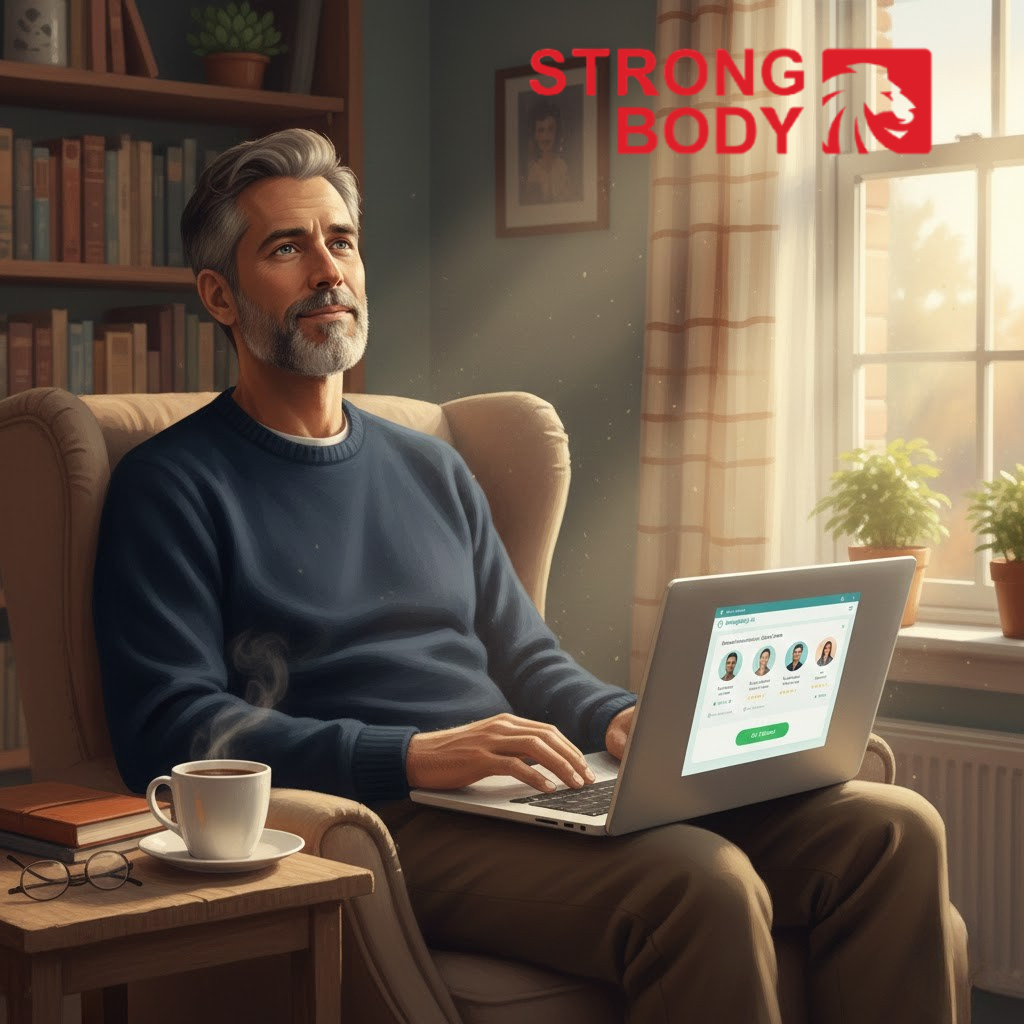
Then the turning point came unexpectedly, on a chilly autumn afternoon, as Sarah scrolled Instagram on her old phone. An ad popped up: “Strongbody AI – Connecting you to real health.” Curious, she clicked and discovered it wasn’t a typical chatbot, but a platform directly connecting clients to real medical experts. Sarah signed up for a trial, and within days, she was matched with Dr. Amelia Foster, a psychologist and women’s health specialist from California, USA, with over 15 years of experience in hormones and emotional health. In the first video consultation, Dr. Foster listened to Sarah comprehensively: from physical (irregular menstrual cycles), mental (anxiety from divorce), lifestyle (chaotic eating habits), to relationships (how she avoided seeing her now-grown daughter). “Sarah, I understand that a major loss like divorce can make us forget ourselves. But let’s start by listening to your body,” Dr. Foster said gently, her warm voice through the screen. Sarah immediately felt the difference compared to previous automated tools – Strongbody AI wasn’t just a digital platform, but a real bridge between people, with a simple user-friendly interface, gentle guiding voice in the app, personalized tracking journal, and plans adjusted to women’s biological cycles. This built trust in Sarah, who was sensitive and previously hurt. However, Strongbody AI also had technical limitations; sometimes video connections lagged due to weak networks in crowded New York, and it couldn’t fully replace in-person meetings, making Sarah occasionally feel a lack of real closeness. Despite this, the platform’s accessibility – no need for travel in a busy city – made it feasible for her limited budget and energy.
The arduous journey began with small changes, under Dr. Foster’s guidance through Strongbody AI. Sarah learned to drink enough water daily, holding a warm herbal tea cup, feeling the mint aroma spread to dispel fatigue. She practiced deep breathing by the window, listening to autumn leaves falling in the nearby park. Going to bed earlier, with a notebook by the bed to jot down emotional journals. Eating full breakfasts: a ripe banana and hot oatmeal. But it wasn’t always smooth. There were relapse days – Sarah stayed up all night because divorce memories flooded back, fatigue made her skip workouts, motivation lost when weight didn’t drop. “I can’t do this anymore, doctor,” Sarah texted late at night through the app. Dr. Foster replied immediately: “Sarah, this journey isn’t linear. Women’s hormones change with cycles, so today’s plan may need adjustment. Try the virtual support group on Strongbody AI – you’re not alone.” Thanks to that, Sarah joined a chat group with other middle-aged women in America, sharing stories under the warm light of the living room. Some days she cried remembering her ex-husband, but then smiled at encouraging messages from the group. This companionship – through texts, calls, and flexible plans – helped Sarah persist, emphasizing that recovery is a process with ups and downs, but always supported. To show Sarah’s personal effort, an important event occurred in the second month. She decided to join a local yoga class on her own, not through Strongbody AI, just based on motivation from consultations. The class was in a small studio in Upper East Side, where she ran into Lisa, her old friend. Sarah hesitated at first but stepped into the room, feeling the lavender essential oil aroma spread and gentle music. “Sarah, you’re here!” Lisa exclaimed, hugging her. In class, Sarah tried the poses despite her stiff body; initially, she almost quit due to muscle pain but remembered Dr. Foster’s words: “She’s just a catalyst, Sarah; you have to effort yourself.” She persevered, and after the session, felt a new energy flow through her body. This event proved that Strongbody AI and Dr. Foster were only motivational supports; Sarah’s efforts were the deciding factor. Following the class, Lisa and Sarah sat at a nearby café, sipping chamomile tea. “I’ve been worried about you,” Lisa said. “What made you come out?” Sarah replied, “A mix of things, but mostly realizing I can’t hide forever.” Their conversation rekindled their friendship, with Lisa sharing her own stresses from work promotions, reminding Sarah that everyone has battles.
Then an unexpected twist happened in the third month of the journey. While walking in Central Park, Sarah suddenly felt intense chest pain, her heart racing irregularly – signs of extreme anxiety combined with hormonal issues. Her hands trembling, she opened the Strongbody AI app immediately. The platform connected her to Dr. Foster in minutes. “Sarah, breathe deeply with me: inhale four seconds, hold seven, exhale eight. I’m calling emergency for you,” Dr. Foster guided through the voice call, her voice calm but urgent. Thanks to that, Sarah was taken to the hospital in time, diagnosed as pain from accumulated stress, not serious cardiac. The hospital doctor confirmed that the quick intervention from Strongbody AI prevented complications. “If there wasn’t this timely connection, things could have been worse,” Sarah later told Emily over the phone. “I’m okay now, thanks to the support.” Emily responded, “Mom, you scared me, but I’m proud of you for proactively seeking help.” This event strengthened her faith in the platform, which doesn’t interfere in treatment but acts as an effective bridge. However, the technical limitation showed when the initial connection delayed a few seconds due to high load, making Sarah panic briefly. After the incident, Emily visited from Boston for a weekend. They walked through the park, leaves crunching underfoot, and Emily opened up about her college stresses. “I didn’t want to burden you, Mom,” she said. Sarah hugged her: “We’re in this together now.” This visit deepened their bond, with Emily encouraging Sarah to continue her routine.
Another event in the recovery journey occurred in the fourth month when Sarah decided to attend an online workshop on women’s health, not directly related to Strongbody AI. The workshop, organized by a non-profit in New York, focused on balancing life after divorce. Sarah signed up to expand her social network. There, she met Laura, another middle-aged woman who had divorced and was now a personal trainer. Laura shared her story, making Sarah feel empathetic. “We’ve all been at the bottom, but standing up ourselves is key,” Laura said in the group discussion. Sarah shared about her journey: “Strongbody AI connected me to experts, but I have to take each step myself.” This conversation became a new motivation; Sarah and Laura kept in touch via texts, encouraging each other with exercises or healthy recipes. The event emphasized that Strongbody AI is a supporting agent, but Sarah’s efforts in building real relationships bring sustainable change. In American society, where middle-aged women often feel excluded from social activities, such events help them reconnect and rediscover themselves. Laura invited Sarah to a hiking group in the Hudson Valley, where they trekked through forested paths, the fresh air filling their lungs, birds chirping overhead. “This is what living feels like,” Sarah thought, her muscles aching but her spirit lifting. They discussed cultural shifts, like how media portrays aging women as invisible, motivating Sarah to challenge that narrative in her own life.
As the months progressed, Sarah incorporated more activities. In the fifth month, she volunteered at a local women’s shelter in Manhattan, drawing from her experiences to counsel others. One day, she met Maria, a younger woman facing similar post-divorce struggles. “How did you get through it?” Maria asked over coffee in the shelter’s kitchen, the aroma of fresh brew mingling with hope. Sarah replied, “Small steps, support, and believing in yourself. Platforms like Strongbody AI helped connect me, but persistence is yours.” This role reversed her from victim to mentor, boosting her confidence. She also reconnected with hobbies, like painting; sitting by the window with pencils and paper, capturing the cityscape as the sun set, colors blending like her emerging emotions. Emily noticed during calls: “Mom, your voice sounds brighter.” Sarah laughed, “I’m painting again – remember how I used to?” These moments wove into her routine, making recovery multifaceted.
Yet challenges persisted. In the sixth month, a work deadline triggered old anxiety; Sarah felt tempted to skip meals. But using her journal from Strongbody AI, she noted triggers and adjusted, texting Dr. Foster for advice. “You’re building resilience,” Dr. Foster encouraged. A minor technical glitch in the app – delayed notifications – frustrated her, but she adapted by setting personal reminders. This highlighted that while Strongbody AI catalyzed change, her adaptability was crucial. Socially, she attended a networking event for freelancers, meeting Tom, a graphic designer. Their coffee chat turned into tentative dates; walking along the High Line, feeling the breeze and hearing street musicians, Sarah felt a gentle spark. “I haven’t felt this in years,” she confided to Lisa over lunch. Lisa nodded, “You deserve it.”
After six months, the results were evident, making Sarah feel reborn. Her skin glowed brighter, no longer dull from balanced nutrition; deep sleep without chronic insomnia; stable mood, anxiety greatly reduced; weight back to healthy levels. She returned to work as a freelancer, feeling energy surge as she walked Broadway’s bustling streets. A small reunion with Emily and old friends at a familiar café evoked revival: laughter echoing, the scent of toasted bread aromatic, hands holding warm latte cups. “Mom looks completely different, like reborn,” Emily said, eyes sparkling. Lisa added, “Sarah, you’re inspiring me to take better care.” Mrs. Margaret, invited, smiled: “You’re back, dear.” Sarah shared with Dr. Foster in the final consultation: “Thank you, doctor, and Strongbody AI. It not only saved my health but taught me proactive happiness care as a woman.” Dr. Foster replied: “Sarah, we women deserve to be heard and supported. Remember, health isn’t a destination but a journey.” The universal message spread: In the isolation of modern American life, where middle-aged women often self-rely, deep connections and proactive care can save lives. But Sarah’s ending didn’t stop there. She began community activities like volunteering at the divorce support center in Manhattan, sharing experiences to help others. She also reconnected with old hobbies like painting, sitting by the window with pencils and drawing paper, feeling inner peace. Emily visited more often, and mother-daughter duo strolled along Hudson River, chatting about futures. Sarah even started dating Tom, feeling light flutters after years of solitude. However, the journey continues; Sarah knows there will be days when hormones fluctuate or work pressures return, but now she has tools and a support network to cope. Ending the journey, Sarah stood by the apartment window, feeling spring wind caress her skin, whispering the philosophy: “Inner harmony starts with listening to yourself before the world listens to you, and that journey never truly ends.”
In expanding her life, Sarah joined a book club focused on women’s empowerment, reading stories of resilience that mirrored her own. Discussions over wine in cozy Brooklyn cafés, with scents of baked goods and pages turning, fostered new friendships. One member, Sophia, shared: “Your story motivates me – how did you start?” Sarah explained, “With one small step, amplified by support like Strongbody AI.” This group became a weekly anchor, discussing societal issues like gender pay gaps and menopause stigma, which Sarah now advocated against. Professionally, her freelance gigs grew; she pitched ideas on women’s health marketing, drawing from personal insights. A client meeting in a sleek Midtown office, with city views and coffee steaming, felt empowering. “Your perspective is unique,” the client said. At home, she revamped her space: fresh plants on windowsills, their earthy smell refreshing, soft rugs underfoot for comfort. Cooking became therapeutic; chopping vegetables with rhythmic knife sounds, steam rising from healthy stews shared with visitors. Emily helped decorate during visits, hanging art: “This place feels alive now, Mom.” Health-wise, Sarah tracked progress beyond the app, joining a gym with Laura, sweating through classes amid motivational music and camaraderie. Setbacks, like a cold disrupting routine, tested her; she rested, using breathing techniques, emerging stronger. Romantically, dates with Tom evolved: picnics in parks, grass tickling feet, conversations flowing like wine. “You’re incredible,” he said one evening under stars. Sarah blushed, “I’m learning to believe that.” Family ties strengthened; a holiday call with extended relatives, once avoided, brought warmth. “We’ve missed you,” an aunt said. Sarah replied, “I’m here now.” Community involvement expanded to speaking at events, her voice steady on stages with spotlights and attentive audiences. “Proactive care saved me,” she shared, inspiring applause. Yet, she acknowledged limitations: Strongbody AI’s occasional glitches reminded her tech isn’t perfect, pushing self-reliance. In quiet moments, journaling by candlelight, wax scent soothing, she reflected on growth. The city outside pulsed, but inside, peace reigned. Sarah’s story illustrates that renewal is ongoing, blending support, effort, and openness to life’s chapters.